How to Keep Your Covered California Plan When You Move Within the Inland Empire or Into the Coachella Valley
Covered California Move Update | Inland Empire

Late summer and early fall are prime “moving months” in Southern California—leases turn over, families shift before school routines lock in, and a lot of people relocate within the Inland Empire or head toward the Coachella Valley for a change of pace. The move itself is stressful enough. What catches many people off guard is how a simple address change can ripple through your Covered California health plan.
If you’re enrolled through Covered California and you move—whether it’s from Riverside to Moreno Valley, Redlands to Yucaipa, or from the Inland Empire down into the Coachella Valley—there are a few steps that protect you from surprise network changes, billing problems, or even an unintended coverage gap.
Below is a practical, move-season checklist focused on one narrow goal: how to update Covered California after moving so you keep coverage that actually works in your new area.
1) Why moves spike in late summer (and why Covered California updates get missed)
When you move, you’re juggling mail forwarding, utilities, DMV, school paperwork, and work schedules. Health insurance often feels like something you can “handle later.” The problem is that Covered California plans are built around service areas and provider networks that can change by ZIP code. Even if you’re staying in California, your plan availability, premium, and doctor network can shift when your address changes.
In practical terms, that means:
- Your current plan might not be offered in the new ZIP code.
- Your doctors or preferred hospital system might be out-of-network after the move.
- Your premium tax credit (subsidy) can change if your household details or income estimate updates at the same time.
- If the update is done incorrectly or late, you can end up with billing confusion or a gap between old and new coverage.
The good news: moving is a recognized life change, and it often triggers a Special Enrollment Period (SEP) that allows plan changes. The key is doing the update in the right order and checking the right items.
2) Step 1: Update your address the right way (and why it can change your plan options)
The most important action is to report the move through your Covered California account rather than only updating your address with the health insurance carrier. Covered California is the marketplace that determines eligibility and plan options; the carrier is the company that administers the plan.
When you update your address in Covered California, you’re not just changing where mail goes. You’re changing your rating region and service area, which can:
- Open new plan options
- Remove old plan options
- Change which provider networks are available
- Change premiums
What to gather before you start:
- Your new address and move-in date
- The names and birthdates of household members on the application
- A current estimate of annual household income (even if it hasn’t changed)
Timing tip: If you know your move date in advance, don’t wait until you’re fully unpacked. The earlier you update, the easier it is to align effective dates and avoid last-minute scrambling.
3) Step 2: Confirm your household + income details so your subsidy doesn’t get recalculated wrong
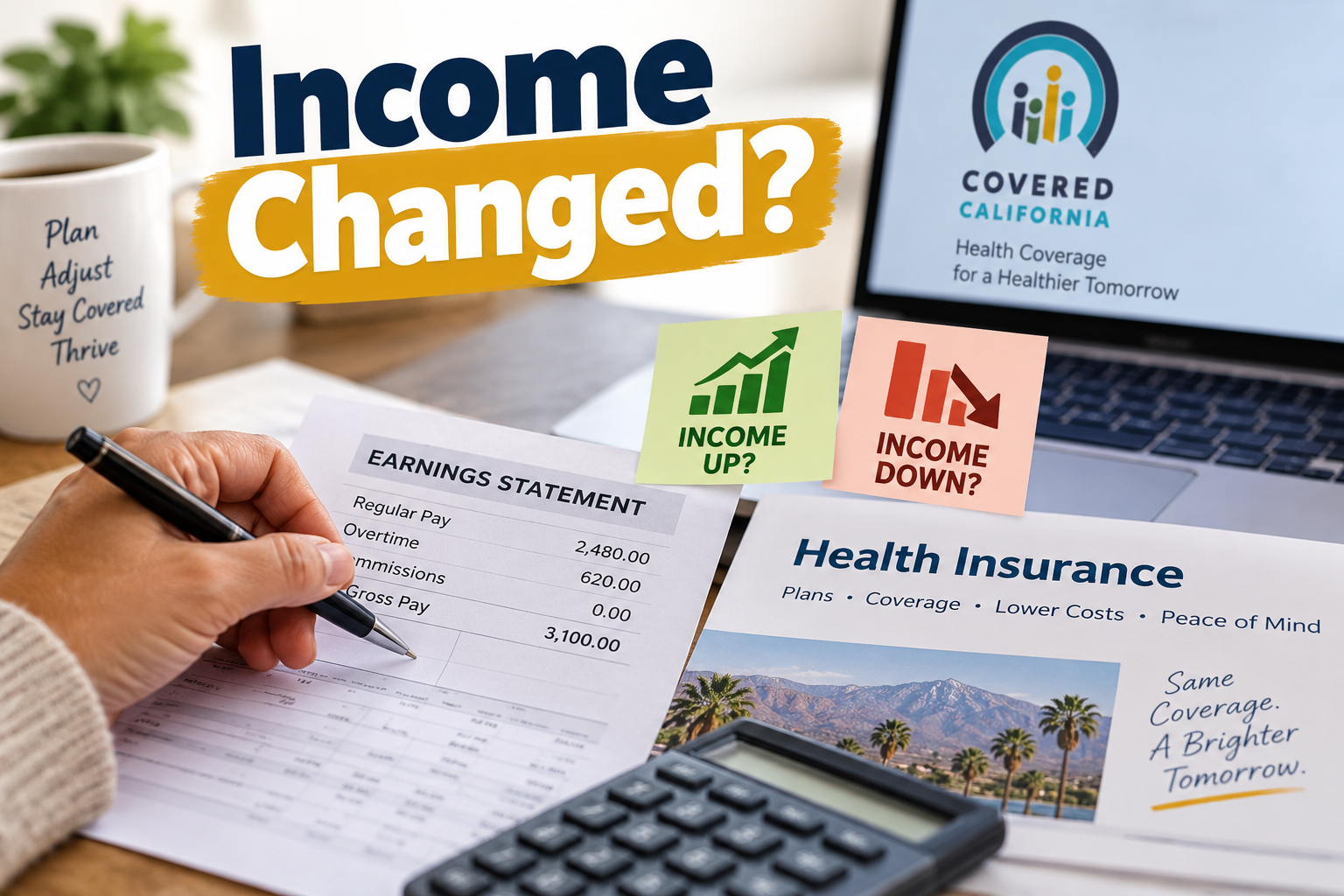
Many people log in to change the address and click through quickly. But the system may prompt you to confirm household and income information. If anything is outdated—like a job change, reduced hours, seasonal work, or a spouse starting work—your premium tax credit can be recalculated.
This is where people get surprised:
- They update the address.
- The system asks for income confirmation.
- They guess, round too low, or forget a source of income.
- Their subsidy changes, and their monthly premium jumps.
A move doesn’t automatically mean your subsidy should change. But the update process is a common moment when errors happen.
Practical guidance:
- Use your best good-faith estimate for the full year (not just this month).
- Include taxable income sources you expect for the year.
- If your income varies (commission, overtime, self-employment), consider using a conservative estimate that reflects your realistic annual total.
If you’re unsure, it’s worth getting help before you submit changes—because fixing a subsidy issue after the fact can take time and can create back-and-forth with documentation.
4) Step 3: Check your doctors, hospitals, and prescriptions in the new ZIP code
This is the step most people skip—and it’s the one that causes the most frustration after a move.
Even if you keep the same carrier name (for example, “Blue” or “Kaiser” or another familiar brand), the specific network and service area rules can change across regions. A plan that worked well in one part of the Inland Empire may not match your needs if you move to a different area, and the Coachella Valley can have different provider availability than cities closer to the LA/Orange County border.
Before you finalize any plan decision after moving, check:
- Primary care doctor: Are they still in-network in the new service area?
- Specialists you use: Especially for ongoing conditions.
- Hospitals and urgent care: Which facilities are in-network near your new home?
- Prescriptions: Confirm your medications are on the formulary and whether prior authorization rules changed.
If you’re moving within Southern California, it’s common to assume “it’s all the same network.” Unfortunately, that assumption can lead to out-of-network bills or the need to switch doctors unexpectedly.
5) Step 4: Avoid the two most common “gap” mistakes (billing and effective dates)
Mistake #1: Paying the wrong entity (or missing the first payment after a change)
After an address change and plan update, people sometimes:
- Assume autopay will carry over (it may not, especially if you change plans)
- Miss a new invoice
- Pay the old plan premium after the new plan is active
The result can be a cancellation for non-payment or a confusing month where the carrier shows you as inactive.
What to do:
- Confirm which plan is active for the upcoming month.
- Confirm where and how the premium must be paid.
- If you changed plans, set up payment again and verify the first month is received.
Mistake #2: Misunderstanding the effective date of the new plan
When you report a move, your plan change typically becomes effective based on marketplace rules and the timing of your update. If you assume coverage switches immediately, you can accidentally create a gap.
What to do:
- Look for the effective date shown in your Covered California confirmation.
- If you have upcoming appointments, verify coverage is active on that date.
- If you’re between places (temporary housing, extended stay, or staying with family), use the address where you actually reside and can receive important mail.
If you’re moving and you have ongoing care—pregnancy, scheduled surgery, chronic condition management—effective dates and network checks matter even more.
6) A quick move checklist + when to ask for help
Here’s a simple checklist you can use the week you move (or the week before):
Move checklist for Covered California
1. Log in and report the address change in your Covered California account.
2. Confirm household members are correct.
3. Confirm annual income estimate is accurate.
4. Review plan availability in the new ZIP code.
5. Check doctors, hospitals, urgent care, and prescriptions.
6. Select a plan if your current plan isn’t available or no longer fits.
7. Verify the effective date.
8. Confirm premium payment method and that the first payment is received.
9. Save confirmation screenshots or emails for your records.
When to ask for help
Consider getting assistance if:
- Your plan disappears after the address change and you’re not sure what to pick.
- Your premium jumps unexpectedly after the update.
- You have dependents, shared custody situations, or a complex household.
- You take specialty medications or have ongoing treatment and need to protect continuity of care.
- You’re moving between Inland Empire cities and the Coachella Valley and want to confirm networks before you commit.
As a local resource with a hyper-local focus in the Southern California Inland Empire and the Coachella Valley, Charise Karjala Health Markets Insurance can help you make the update cleanly, verify plan options in your new ZIP code, and reduce the chance of surprises—without guessing your way through the process.
Moving is already a lot. Your health coverage shouldn’t be the thing that breaks at the worst possible time.
If you’re moving within the Inland Empire or into the Coachella Valley and want to update your Covered California plan without coverage gaps or network surprises, contact Charise Karjala Health Markets Insurance for help reviewing your options and confirming your effective date and payments. (760) 831-2736